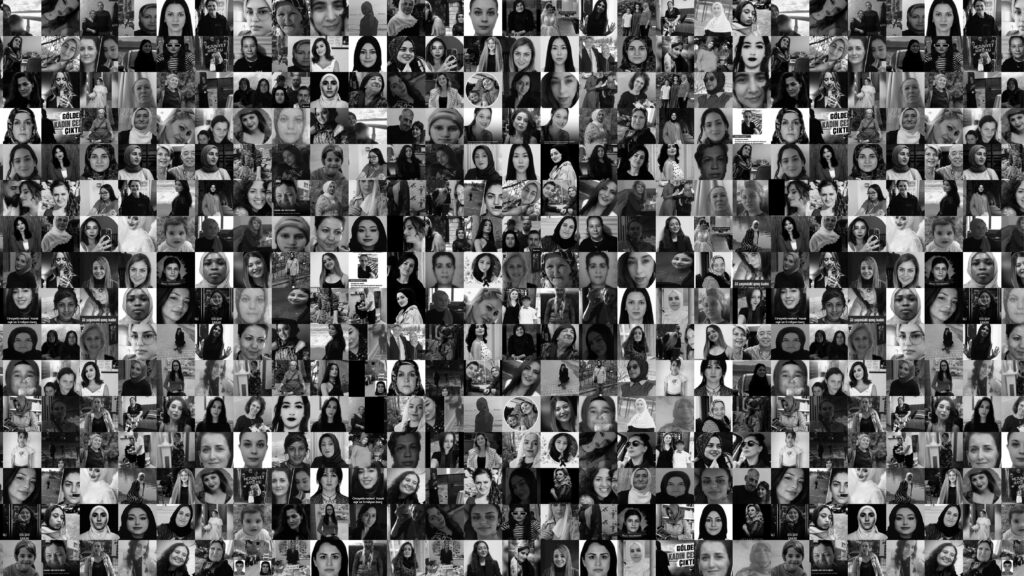
Let us say at the outset what we would otherwise leave until the end.
Every 25 November, as we remember the women whose dreams, hopes and the lives they wanted to live were taken from them, whose names sometimes disappear into a newspaper report and sometimes into a court file and for whom no one is held to account, we do not simply mourn those we have lost. We also challenge the male violence that took them from life, the inequality that fuels that violence and a system that fails to protect women while surrounding perpetrators with impunity. Because we know that femicides are not isolated incidents. They are political. Violence is not accidental. It is the consequence of a patriarchal order that seeks to control women’s lives, bodies and labour.
We, as women, are not condemned to live in fear, submit to violence or give up our rights. At home, on the streets, in the workplace and in every sphere of life, we demand an equal and free life without violence. We amplify one another’s voices and strengthen one another’s struggles. We do not forget the lives cut short, the unfinished dreams or the pursuit of justice of the women who have been killed. Drawing strength from one another, from our solidarity and from our organised struggle, we raise our voices against male violence. Our struggle will continue until we build a world in which no woman loses her life to violence and no woman is forced to fight simply to live without fear.
25 November is the day on which we honour the memory of the Mirabal sisters, who were murdered in 1960 for resisting the dictatorship in the Dominican Republic and strengthen our struggle against violence against women. The resistance of Patria, Minerva and María Teresa Mirabal Reyes continues to inspire women across the world who are fighting for equality, freedom and the right to life. Despite the years that have passed, the gains women have made and the growing strength of their struggle, violence against women continues to threaten women’s lives everywhere. Women face different forms of violence not only at home but also on the streets, in workplaces, at school, on public transport and in the digital sphere. Femicides, sexual assault, harassment, threats, stalking, psychological abuse and economic violence continue to surround women’s lives.
Violence against women is neither isolated, unplanned nor without consequence. It is a political act with deep historical and social roots. It is the product of patriarchy and gender inequality, of an order that does not regard women as equal to men and assumes the right to exercise control over women’s lives and bodies. Policies that prevent women from living as equal citizens and restrict their rights and freedoms fuel this violence.
Femicides Are Political!
In Turkey today, women are not only fighting male violence. They are fighting, and being killed by, a patriarchal order that assumes the right to control their lives, bodies, labour and decisions. In the 327 days between 1 January and 23 November 2026, men killed at least 261 women and injured at least 524 women. The deaths of at least 439 women were reported in the media as “suspicious”. Every time those responsible for protecting women’s right to life fail to fulfil their duties, reports of violence go unanswered, protection orders are not effectively enforced and perpetrators are rewarded with impunity, male violence grows stronger. Protecting women’s lives requires more than issuing statements after women have been killed. It requires implementing policies that eliminate the inequalities from which violence arises.
Violence against women cannot be separated from the inequalities women face in the world of work. Women workers are forced to contend with low pay, insecure employment, discrimination, harassment, workplace bullying and male-dominated workplace relations. Psychological pressure, sexual harassment and economic violence in the workplace threaten women’s right to work, their economic independence and their freedom of association. At the same time, preventing women from working, taking control of their income, restricting their access to economic resources and condemning them to economic dependence creates a vicious circle that also makes it more difficult for women to escape violent environments. Secure employment, equal pay for equal work and social security are essential if women are to achieve economic independence.
Moreover, the unpaid care burden placed on women remains one of the greatest barriers to their participation in the labour market. Treating the care of children, older people, people who are ill and persons with disabilities as the natural responsibility of women pushes them out of the labour market and confines them to low-paid, flexible and insecure work. In Turkey, where 30 per cent of women live below the poverty line and women’s unemployment exceeds 11 per cent, the fact that only TRY 11 billion is allocated from the public budget to the “women’s empowerment” programme is itself a product of these policies. The budget allocation for each woman to confront violence and poverty amounts to just TRY 0.70.
Today, attacks on women’s hard-won rights, policies targeting gender equality and interference in women’s ways of life demonstrate how inadequate the fight against violence remains. Turkey’s withdrawal from the Istanbul Convention, the failure to implement Law No. 6284 effectively and practices that roll back women’s rights continue to leave women without protection. Yet women’s right to life, equality and freedom cannot be made subject to any political agenda or social pressure. The fight against violence against women cannot be left on women’s shoulders alone. The state, employers, local authorities and all social institutions must assume responsibility. Preventing violence, protecting women, effectively investigating perpetrators and ensuring that women can live equal, free and safe lives are public responsibilities.
At a time when women’s decisions concerning divorce, alimony, employment, how they dress, living alone and their own lives are increasingly made subject to social pressure and political interference, attempts to limit the right to alimony according to the length of a marriage also disregard both the violence and economic exploitation women experience during marriage and the poverty they may face after divorce. Women are expected, on the one hand, to endure violence and, on the other, to pay the price when they seek to build lives of their own. Yet women’s freedom does not depend on the approval of others, the duration of a marriage or the permission and decisions of men.
In a system where violence is fuelled by impunity and women’s rights are opened up for debate, injustice, fear and inequality confront women as three separate walls. We will tear down those walls through our solidarity, our organised struggle and by standing up for one another’s lives. Together, we will build a country in which no woman is killed, no woman is condemned to a life of violence and every woman is free to make decisions about her own life. As women of DISK/GENEL-IS, we say clearly that there can be no genuine equality, justice or democracy in a society where women are not free. The struggle for women’s right to life is an inseparable part of the struggle for labour rights, trade union freedoms and democracy. We are strengthening our struggle for a country and a world in which women are not subjected to violence at home, on the streets or in the workplace, where their labour is not devalued and where they can live equally and freely.
We Reiterate Our Demands, We Will Not Give Up the Struggle!
- Turkey must rejoin the Istanbul Convention and Law No. 6284 must be implemented fully and effectively.
- Turkey must ratify ILO Convention No. 190 on Violence and Harassment and ensure its effective implementation in the world of work.
- Policies of impunity in cases of femicide and gender-based crimes must end, as must sentence reductions based on “unjust provocation” and “good conduct”.
- Effective mechanisms must be established to prevent physical, sexual, psychological, economic and digital violence against women. Women’s access to reporting, support and protection mechanisms must be strengthened.
- Effective prevention, reporting and sanction mechanisms must be established against violence, sexual harassment and workplace bullying. Safe working conditions for women workers must be guaranteed.
- To strengthen women’s economic independence, secure, full-time and decent employment opportunities must be created. Gender discrimination in recruitment, promotion and pay must end.
- The principles of equal pay for equal work and equal pay for work of equal value must be implemented.
- Women’s unpaid care work must be recognised as a social responsibility. Nurseries, day-care facilities and care centres for older people and people who are ill must be expanded as public, high-quality and free services.
- Parental leave must be established as a paid and secure right that can be shared equally between women and men.
- The barriers preventing women’s equal participation in trade union organisation and decision-making mechanisms must be removed.
- Gender equality must become a fundamental principle of all public policy.
We will not give up our right to life, our labour, our bodies or our freedom. Together, we will build a life without violence, inequality or exploitation.
“Like dust, still I’ll rise, still we’ll rise.”
Maya Angelou
Long Live Women’s Solidarity!
Long Live Women’s Organised Struggle!